
A “food safe” sticker on a plastic tub does not make it safe for hot sambar or oily pickle. The label only means one chemical was replaced with a substitute that still moves into food under heat and fat. Real safety depends on the resin code stamped on the base and on how well the plastic resists lipid-induced migration, the process where hot oil pulls additives into your meal.
Peer-reviewed polymer science documents this exchange, showing BPA-free plastics release estrogenic chemicals into fatty simulants when heated — the data behind which plastic containers are safe for storing hot food and oil in India. The orange stain, the sticky grease, and the curry smell on old tubs are the visible markers of that same chemistry. Matching the stamped number to a simple decision tree stops it.
Why “BPA-free” plastics still leach into hot sambar and oily pickles
Plastics are hydrophobic polymer matrices, which means oil is exactly the kind of substance that soaks into them. Once hot sambar or mustard oil sits above roughly 60°C, the fat acts as a solvent and pulls plasticizers, stabilizers, and leftover monomers out of the surface. A “BPA-free” stamp does not interrupt that process, because it only names the substitute chemistry.
Home cooks describe the visible side of this exchange, and on Cooking Stack Exchange, users ask why tubs used for oily curries stay permanently stained, sticky, and smelly despite washing. As one poster put it, “reheating my food up… leaves stains and smells”. Polymer migration research resolves the complaint: the same hydrophobic surface that absorbs curcumin and capsaicin simultaneously releases stabilizers into the food.
The substitute chemicals carry their own problems. Toxicology work shows BPA-free plastics release estrogenic chemicals into fatty-food simulants at elevated temperatures, while paediatric research documents BPS and phthalate leaching from plasticware marketed as BPA-free. A label change therefore removes bisphenol A, not the leaching behaviour.
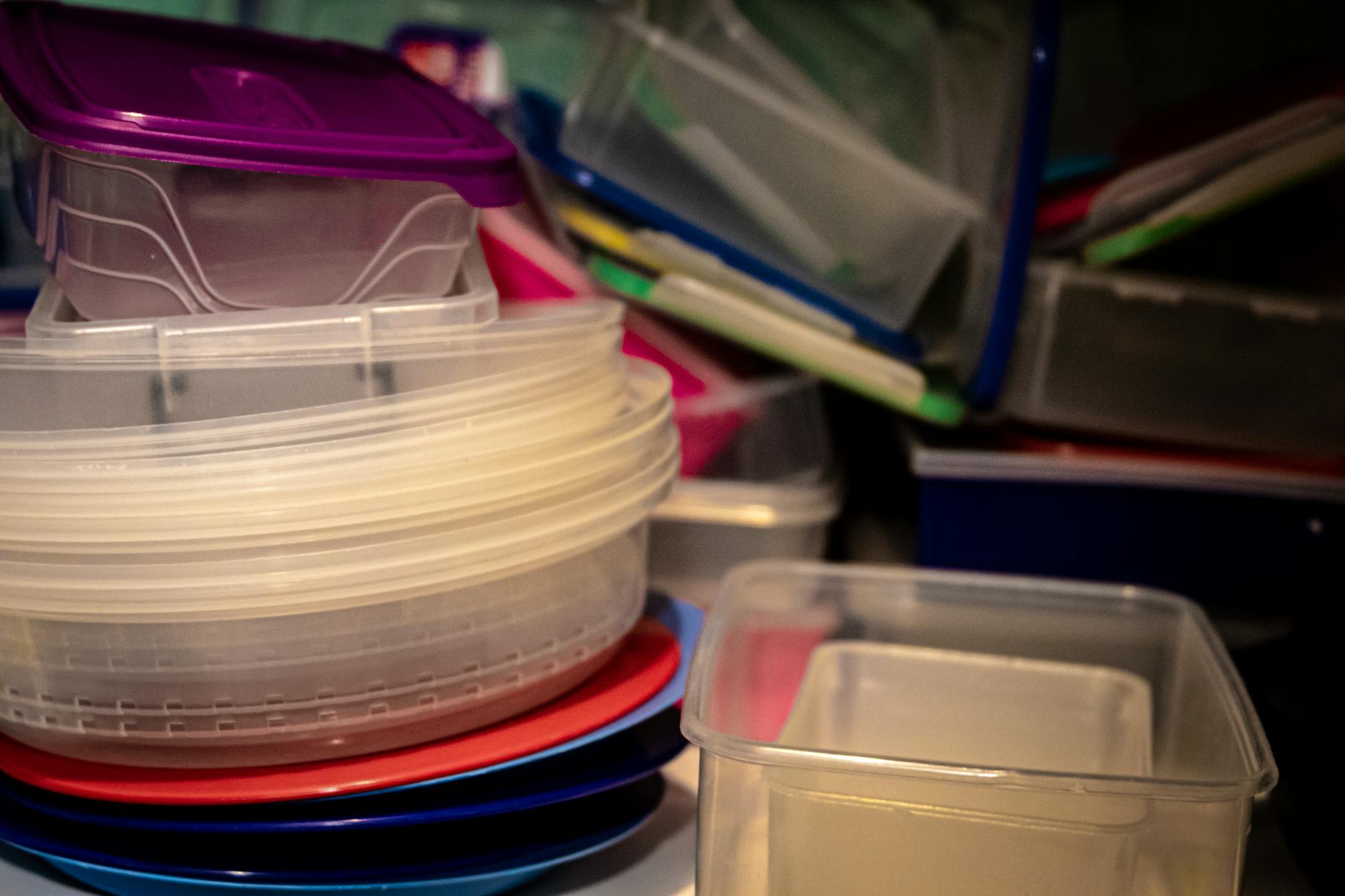
After a few months of weekly curry storage, the permanent orange stain, the grease that survives scrubbing, and the lingering smell take hold on the tub. Those marks are not only food residue, because they show a polymer that has absorbed lipids and roughened, which typically accelerates future migration.
How to read plastic resin codes on Indian containers for hot food and oil
Flip any tub and search the base for a small stamped triangle carrying a number from 1 to 7, the Resin Identification Code, or RIC. That number names the polymer family, and the polymer family sets the container’s heat and fat resistance. Online listings routinely omit it, so the stamp ends up being the only specification you can verify at home.
Examining the base stamp also explains why two identical-looking tubs behave differently with hot food. PET (RIC 1) and polystyrene (RIC 6) warp and leach heavily at Indian serving temperatures of 60°C and above. Polycarbonate, usually hiding inside RIC 7, is the polymer built from BPA, so it should never hold hot food in the polycarbonate-vs-polypropylene comparison.
Polypropylene (PP, RIC 5) is the most heat-resistant common plastic and copes well with warm, low-fat food. Repeated contact with hot ghee or mustard oil still penetrates its matrix over reuse cycles, so food safe plastic for oily food storage remains a relative claim, not an absolute one.

The “microwave-safe” trap for oily foods
A “microwave-safe” mark certifies only that the container will not melt, warp, or catch fire under standard microwave radiation. It says nothing about chemical migration when the oil in your curry hits localized hotspots above 100°C while the plastic wall stays cooler to the touch.
Oily Indian food heats unevenly, and those fat hotspots aggressively extract plasticizers even when the tub feels safe to touch. Work on chemical migration into food simulants shows migration rates climbing with temperature in fatty simulants, which is why the label is a structural durability claim, not a chemical inertness claim for hot lipids.
The FSSAI packaging gap: what “food grade” actually certifies
The FSSAI packaging regulations set Overall Migration Limits and Specific Migration Limits for heavy metals and monomers in food-contact plastics. Those limits define a regulatory baseline for acute toxicity rather than zero chemical exchange.
The compliance tests behind them typically use standard simulants like water, dilute acetic acid, and ethanol, which do not replicate the solvent action of hot mustard oil or ghee across hundreds of reuse cycles. A FSSAI approved plastic container can therefore be legitimately certified for single-use or dry-goods packaging yet still fail against daily hot-curry storage in a joint-family kitchen.
Buyers who repurpose certified single-use tubs for daily curry storage consistently notice the staining and smell described earlier. The certification never tested that use case, so the tub degrades exactly where the label’s coverage ends.
“Food grade” is thus a floor, not a ceiling, for chemical leaching in plastic containers. Once plastics are understood this way, the broader method for verifying BIS and FSSAI marks on dry and cold storage tubs is covered in How to Identify Food-Grade Storage Containers That Actually Meet Indian Safety Standards.
Glass, steel, or plastic: matching the material to the Indian ingredient
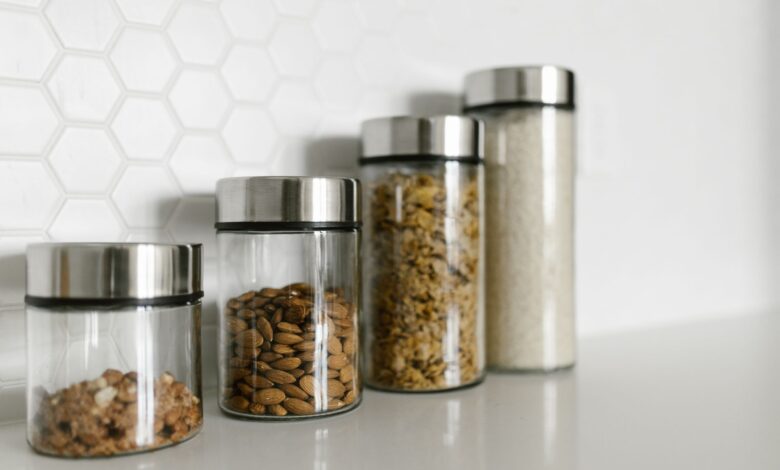
Borosilicate glass and 304-grade stainless steel share one property no plastic can offer, a non-porous, chemically inert surface that fats cannot penetrate. Research comparing inert packaging alternatives to polymer matrices puts glass and metal migration at effectively zero, while plastics stay semi-permeable.
Match the material to the ingredient. Glass and steel take the hot, oily, and acidic load such as sambar, mango pickle, and ghee, because neither heat nor fat opens a migration path, which settles the glass vs plastic question for oil storage in India. Good PP (RIC 5) earns its shelf space strictly for dry, cold, low-fat staples like rice, dal, and whole spices, where the absence of heat and lipids prevents polymer penetration.
The trade-off is real, because glass breaks, steel hides its contents, and both cost more per litre than plastic. That extra price buys the elimination of the migration variable entirely, which is why many kitchens settle on a split system with inert materials for wet cooking storage and PP for the dry shelf.

Check the inner wall by running a fingernail along it after washing. A rough, sticky, or catching feel means the polymer surface has degraded and turned more porous, accelerating future leaching, while a glass-smooth feel means the surface is still intact.
The chemical safety decision tree: which plastic containers are safe for storing hot food and oil in India
Apply this three-branch check before any container meets food: identify the food type and temperature first, then let the chemistry pick the material. The tree condenses the polymer migration science and the FSSAI simulant limits above into a single kitchen rule.
Hot and oily: curries, pickles, ghee, sambar
Only glass or 304 steel passes this branch. Above roughly 60°C, fats act as a solvent on every common plastic, so no resin code qualifies.
Acidic and wet: tomato bases, tamarind chutneys, fermented batters
Glass or food-grade steel again. Acidic compounds speed up monomer extraction from plastics even at room temperature, which is why pickle and chutney should never sit against polymer walls.
Dry and cold: whole spices, rice, dal, flour
PP (RIC 5) plastic is acceptable and cost-effective here. With neither heat nor fats present, the polymer penetration that drives migration cannot start.
Buyers who move pickle storage from plastic to glass consistently notice the oil and brine stay clearer over the following weeks. An inert wall adds no dissolved additives to the liquid, so nothing clouds it. The tree’s logic holds across every branch, because heat and lipids decide the material, not the marketing label.
The bottom line
Labels like “BPA-free” and “food grade” mark a regulatory floor, not real protection once hot oil and acidic ingredients meet plastic. Read the resin code on every tub in the kitchen, keep RIC 1, 6, and 7 for dry cold storage, and move curries, ghee, and pickles into glass or steel. Hot fats left in degrading plastic mean daily plasticizer exposure continues, while inert walls remove the variable entirely.
Frequently Asked Questions
Is it safe to store homemade ghee or mango pickle in BPA-free plastic containers?
Ghee and mango pickle should not sit in BPA-free plastic, because those fats and acids penetrate the polymer and extract stabilizers over time. Glass or 304-grade stainless steel remain the only inert options for storing such ingredients.
How does the chemical leaching from PP (RIC 5) compare to borosilicate glass when storing hot dal?
Borosilicate glass is an inorganic silicate matrix that shows zero chemical migration at any temperature. Polypropylene stays an organic polymer, so hot dal’s fats still cause measurable lipid-induced migration each time they contact its walls.
Can I use a “microwave-safe” plastic container to reheat oily curries if I let it cool first?
Cooling the tub afterwards does not remove the risk, because fat hotspots formed during microwaving already extracted plasticizers from the walls at peak temperature. Transfer oily curries to glass before reheating instead.
Do FSSAI-approved plastic containers guarantee zero chemical migration into Indian foods?
They do not, because FSSAI approval certifies baseline Overall Migration Limits using standard simulants like water or dilute acetic acid. Those tests never replicate the hot saturated fats of Indian cooking across hundreds of home reuse cycles.
